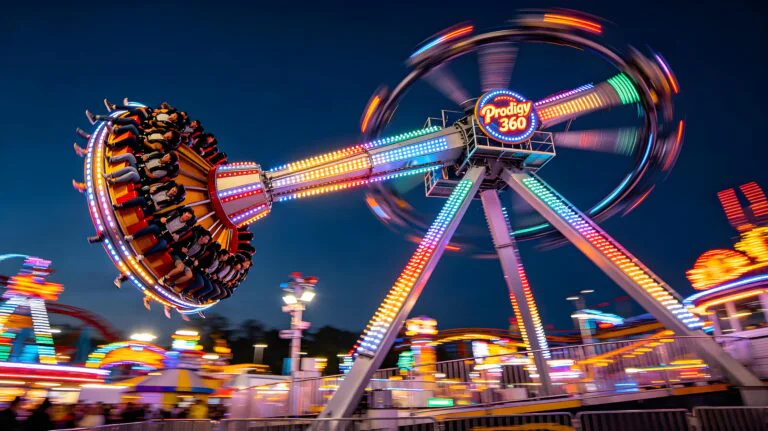
he amusement industry offers a wide variety of attractions designed to entertain guests and generate revenue. For investors, amusement park operators, carnival owners, and event organizers, one of the most important decisions is choosing between portable trailer rides and traditional amusement rides.

While both options can attract visitors and create profitable business opportunities, they differ significantly in terms of cost, flexibility, installation, maintenance, and return on investment. Understanding these differences can help buyers make informed decisions that align with their business goals.

What Are Portable Trailer Rides?
Portable trailer rides are amusement attractions mounted on specially engineered trailers that allow them to be transported easily between locations.
Popular examples include:
- Portable Ferris Wheels
- Mobile Pirate Ship Rides
- Trailer-Mounted Flying UFO Rides
- Portable Samba Rides
- Mobile Swing Rides
- Portable Carousels
These rides are commonly used at:
- Traveling carnivals
- Community festivals
- County fairs
- Seasonal events
- Corporate gatherings
- Temporary amusement parks
Their primary advantage is mobility, allowing operators to serve multiple venues throughout the year.
What Are Traditional Amusement Rides?
Traditional amusement rides are permanent attractions installed at fixed locations such as theme parks and amusement centers.
Examples include:
- Large roller coasters
- Permanent Ferris wheels
- Water rides
- Observation towers
- Giant pendulum rides
- Indoor amusement attractions
These rides are typically built on permanent foundations and require substantial infrastructure investments.
Initial Investment Comparison
Portable Trailer Rides
One of the biggest advantages of portable trailer rides is their lower startup cost.
Benefits include:
- Minimal site preparation
- No permanent foundations
- Lower installation expenses
- Reduced permitting requirements
- Faster deployment
Many small and medium-sized businesses choose portable rides because they offer a more affordable entry point into the amusement industry.
Traditional Amusement Rides
Traditional rides generally require a much larger financial commitment.
Costs may include:
- Land acquisition
- Construction work
- Utility installations
- Engineering studies
- Long-term infrastructure development
For many investors, these additional expenses significantly increase project budgets and financial risk.
Winner: Portable Trailer Rides
Mobility and Flexibility
Portable Trailer Rides
Mobility is the defining feature of portable trailer rides.
Operators can:
- Travel to different cities
- Attend multiple festivals
- Follow seasonal demand
- Enter new markets
- Relocate based on event schedules
This flexibility creates more revenue opportunities and reduces dependence on a single location.
Traditional Amusement Rides
Permanent rides are restricted to one venue.
While they may attract consistent visitors, operators cannot move the attraction to capture new audiences or participate in special events.
Winner: Portable Trailer Rides
Revenue Opportunities
Portable Trailer Rides
Portable rides can generate income from multiple sources:
- Ticket sales
- Ride rentals
- Festival contracts
- Corporate events
- Community celebrations
Because they can operate at numerous venues annually, operators often achieve higher asset utilization.
Traditional Amusement Rides
Traditional rides generate revenue primarily through attendance at a fixed location.
Success depends heavily on:
- Local tourism
- Park marketing
- Seasonal traffic
- Geographic location
A poor location can limit earning potential regardless of ride quality.
Winner: Portable Trailer Rides
Installation and Setup
Portable Trailer Rides
Modern trailer-mounted rides are designed for quick assembly.
Advantages include:
- Rapid setup
- Fast dismantling
- Lower labor requirements
- Reduced downtime
Many portable rides can be operational within a single day.
Traditional Amusement Rides
Permanent attractions often require:
- Extensive construction
- Foundation work
- Utility connections
- Inspection approvals
Installation timelines can range from several weeks to several months.
Winner: Portable Trailer Rides
Capacity and Ride Experience
Portable Trailer Rides
Portable rides provide exciting experiences while maintaining transportation efficiency.
However, size restrictions may limit:
- Passenger capacity
- Ride height
- Track length
- Overall scale
Traditional Amusement Rides
Permanent rides can be built on a much larger scale.
Benefits include:
- Higher capacity
- More elaborate designs
- Longer ride cycles
- Greater visual impact
Major theme parks often rely on these large attractions to create destination experiences.
Winner: Traditional Amusement Rides
Maintenance Requirements
Portable Trailer Rides
Portable rides are typically engineered for durability and frequent transportation.
Benefits include:
- Easier inspections
- Simplified maintenance
- Lower repair costs
- Accessible components
Routine maintenance can often be completed quickly between events.
Traditional Amusement Rides
Large permanent attractions usually require:
- Specialized technicians
- Complex repair procedures
- Extensive downtime
- Higher maintenance budgets
As ride complexity increases, maintenance expenses often rise as well.
Winner: Portable Trailer Rides
Scalability
Portable Trailer Rides
Growing a portable ride business is relatively straightforward.
Operators can:
- Purchase one ride
- Build a customer base
- Add additional attractions
- Expand service areas
- Create a traveling amusement operation
This scalable approach helps minimize financial risk.
Traditional Amusement Rides
Expanding a fixed-location amusement park often requires:
- Additional land
- New construction projects
- Significant capital investment
- Regulatory approvals
Expansion can be costly and time-consuming.
Winner: Portable Trailer Rides
Long-Term Business Risk
Portable Trailer Rides
Portable rides offer greater business resilience because operators can adapt to changing market conditions.
If demand decreases in one region, rides can be relocated to another market.
Traditional Amusement Rides
Permanent attractions are tied to a single location.
Factors such as:
- Economic downturns
- Tourism declines
- Population changes
- Local competition
can directly affect profitability.
Winner: Portable Trailer Rides
Comparison Table
| Feature | Portable Trailer Rides | Traditional Amusement Rides |
|---|---|---|
| Initial Cost | Lower | Higher |
| Mobility | Excellent | None |
| Setup Time | Fast | Slow |
| Revenue Sources | Multiple Locations | Single Location |
| Maintenance Cost | Lower | Higher |
| Flexibility | High | Limited |
| Scalability | Easier | More Complex |
| Ride Capacity | Moderate | High |
| Visual Impact | Moderate | Very High |
| Long-Term Risk | Lower | Higher |
Which Option Is Best for Your Business?
Choose Portable Trailer Rides If:
- You operate a carnival or fair business.
- You attend seasonal events.
- You want lower startup costs.
- You need operational flexibility.
- You plan to serve multiple markets.
Choose Traditional Amusement Rides If:
- You own a permanent amusement park.
- You have significant capital available.
- You want large-scale attractions.
- Your business relies on destination tourism.
- You require maximum passenger capacity.
Future Industry Trends
The growing popularity of outdoor festivals, traveling events, and temporary entertainment venues is driving demand for portable trailer rides worldwide.
Key trends include:
- Increased investment in mobile attractions
- Faster ride setup technologies
- Improved transportation systems
- Enhanced safety standards
- Growing rental market opportunities
As event-based entertainment continues to expand, portable trailer rides are becoming one of the most attractive investment options in the amusement industry.
Conclusion
When comparing portable trailer rides vs traditional amusement rides, the best choice ultimately depends on your business model and objectives. Traditional rides offer impressive scale and capacity, making them ideal for permanent theme parks. However, portable trailer rides provide greater flexibility, lower startup costs, easier expansion, and access to multiple revenue streams.
For entrepreneurs, carnival operators, festival organizers, and rental companies, portable trailer rides often deliver a stronger return on investment while reducing financial risk. As the demand for mobile entertainment continues to grow, portable trailer rides are increasingly becoming the preferred solution for modern amusement businesses.