The portable amusement rides disco tagada ride has emerged as one of the most sought-after attractions for carnival operators, amusement park owners, and event organizers worldwide. Combining high-energy spinning motion, pulsating music, vibrant LED lighting, and the convenience of trailer-mounted mobility, this thrilling attraction delivers an unforgettable experience while maximizing return on investment for business owners. This comprehensive guide explores everything you need to know about the portable disco tagada ride, from market trends and technical specifications to safety standards and operational best practices.
What Is a Disco Tagada Ride?
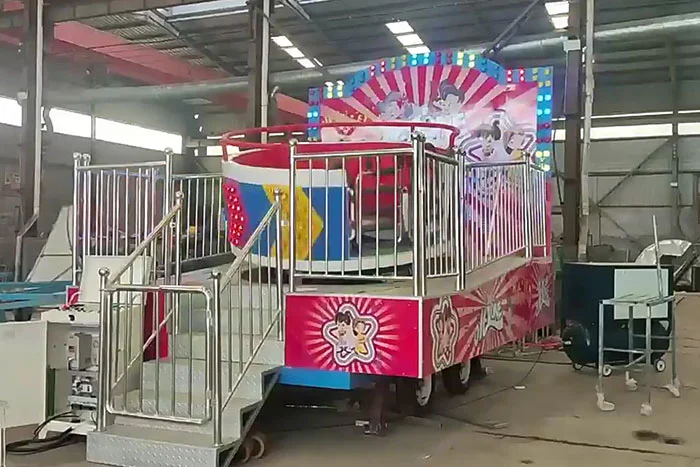
A disco tagada ride (also known as a tagada disco ride, crazy disco turntable, or tremble ride) is an amusement attraction consisting of a large circular bowl or platform where riders sit along the perimeter. As the ride begins to spin, riders experience thrilling centrifugal motion while holding onto raised safety bars behind them. Unlike traditional amusement rides, the disco tagada features no seatbelts or over-the-shoulder restraints, instead relying on centrifugal force, sturdy handrails, and an enclosed bowl-shaped barrier to keep riders safely contained during the high-energy spinning and bouncing sequences. The ride also incorporates hydraulic or pneumatic cylinders that create sudden, unpredictable bouncing motions synchronized with loud, upbeat music to deliver an adrenaline-pumping experience.
The tagada rides amusement park equipment is often described as a “moving dance floor,” where riders bounce and sway to the rhythm of the music while the platform spins and tilts at varying speeds. This unique combination of movement, sound, and light creates a highly interactive social atmosphere that draws crowds and encourages repeat ridership.
Why Choose a Portable Disco Tagada Ride?
The portable amusement rides disco tagada ride offers distinct advantages over permanently installed attractions. Here is why savvy investors are increasingly turning to portable models for their amusement businesses:

1. True Mobility for Maximum Flexibility
Portable disco tagada rides are engineered for frequent relocation. Unlike fixed installations that require permanent foundations, these rides can be transported to various venues: temple fairs, pop-up carnivals, trade shows, shopping malls, resorts, and seasonal festivals. Many models feature integrated trailers, reducing setup time by up to 50% compared to traditional installations. This mobility allows operators to chase peak season demand across multiple locations rather than relying on a single venue.
2. Lower Initial Investment
The portable design typically costs significantly less than permanent rides of comparable capacity, making it an attractive entry point for new operators. A small mini disco tagada (8–12 seats) can cost between 5,800and7,200, while medium 16-passenger models range from 8,000to13,000. Larger 24-passenger portable units are priced between 19,800and25,000. By comparison, fixed large-scale park rides can exceed $100,000, making portable models a much more accessible option.
3. High Revenue Potential with Fast ROI
The disco tagada ride typically generates high daily revenue thanks to its short cycle times and group capacity. With popular models accommodating 16 to 40 passengers per cycle and a typical ride duration of 3–5 minutes, it is not uncommon for well-positioned portable disco tagada rides to recover the initial investment within the first 3 to 6 months of operation, depending on traffic and local pricing.
4. Compact Footprint
These portable tagada rides require relatively small operational areas, making them suitable for locations with space constraints. Mini models can operate within a 5 × 6 meter area, while standard 24-passenger versions need approximately 8 × 8 meters. This flexibility opens up installation opportunities in indoor entertainment centers, mall atriums, and plaza events where space is at a premium.
Market Outlook: The Growing Demand for Portable Amusement Rides
The global small amusement device market is experiencing steady growth, projected to reach 3,023millionby2032ataCAGRof5.32.21 billion in 2025 and is forecast to expand to $3.77 billion by 2034 at a CAGR of 6.22%.
Asia Pacific currently dominates the market with a 47.25% share, driven by rapid urbanization, increasing tourism infrastructure, and the growing number of family-oriented entertainment facilities in countries such as China, India, and Japan. Meanwhile, markets in the Middle East, Europe, and North America continue to see sustained demand for portable carnival equipment as event organizers and mall operators seek high-impact attractions that can be deployed quickly and cost-effectively.
The trend toward “gamified” and interactive rides is also shaping the industry. The year 2026 marks a turning point where traditional mechanical rides are fully integrating with augmented reality (AR) and eco-friendly power systems. Many new disco tagada models now feature programmable LED light shows, high-fidelity sound systems, and operator-controlled bounce sequences that can be customized in real time.
Key Technical Specifications of Portable Disco Tagada Rides
When comparing portable tagada rides for sale, several key technical parameters determine performance, safety, and suitability for different venues.
Passenger Capacity
Portable disco tagada rides are available in multiple configurations:
| Model | Passenger Capacity | Typical Cover Area | Power Requirement |
|---|---|---|---|
| Mini Tagada | 8–12 seats | 5 × 6 m (30 m²) | 12–13 kW |
| Standard Tagada | 16–24 seats | 6 × 7 m to 9 × 10 m | 15–25 kW |
| Large Tagada | 30–40 seats | 10 × 10 m (100 m²) | 25–35 kW |
Most high-capacity portable models support a maximum load of 500 kg and are built from durable steel and fiberglass (FRP) materials, striking an ideal balance between structural strength and transport weight. The inclusion of a heavy-duty trailer system ensures smooth relocation between venues without requiring disassembly in many models.
Power and Voltage
Almost all commercial disco tagada rides operate on a 380V AC three-phase power supply. Typical power consumption ranges from 20 kW for standard models up to 30 kW or more for large-capacity versions equipped with dual compressors for pneumatic bouncing.
Dimensions and Height
- Mini Tagada: Height approximately 2.1 m, suitable for indoor venues with limited ceiling clearance.
- Standard Models (16–24 seats): Equipment height 4–5 m, with an 8-meter diameter platform.
- Large Models (30–40 seats): Height up to 5.5 m, platform diameter up to 6 meters, requiring a minimum of 12 × 8 m overall operational footprint.
Materials and Construction
Reputable portable tagada rides utilize corrosion-resistant steel frames reinforced with fiberglass-reinforced plastic (FRP) components. This composite construction reduces weight by approximately 20% compared to all-steel designs while maintaining structural integrity in outdoor environments. The interior of the bowl is typically lined with high-density shock-absorbing marine foam and premium wear-resistant leather to ensure passenger safety during intense bouncing.
Lighting and Sound
Modern portable disco tagada rides come equipped with programmable RGB LED lighting systems that can be synchronized with onboard music. The lighting systems offer multiple dynamic modes including pulsating, color-shifting, and music-reactive sequences, allowing the operator to match visuals to event themes. Many units also include integrated high-fidelity sound systems that enable the operator to manually sync spinning and bouncing sequences to the beat of the music, creating a unique DJ-controlled experience.
Safety Standards and Certifications
Safety is paramount when purchasing portable amusement rides. Globally recognized certifications demonstrate a manufacturer‘s commitment to meeting rigorous safety requirements.
Key Certifications to Verify
- CE Certification: Required for amusement equipment sold in the European Union; confirms compliance with EU safety directives for machinery and electrical systems.
- EN 13814 Standard: The primary safety standard for fairground and amusement park machinery, covering design, calculation, manufacture, installation, maintenance, operation, inspection, and testing of amusement devices.
- ISO 9001: Quality management system certification indicating consistent manufacturing processes.
- ASTM F24: Standard applicable for amusement rides entering the United States market.
- ISO 13849-1: Safety of machinery standard focused on control system reliability and functional safety.
EN 13814-1:2024 Update
It is important to be aware that EN 13814-1:2019 is being revised by the addition of Amendment 1 (A1:2024), which was approved in June 2024. This means that more stringent requirements are now in effect for amusement devices sold into the European market. Any buyer importing into Europe must ensure their ride meets the latest amendment.
EN 13814-2: Maintenance, Operation and Testing
In addition to design and manufacturing standards, EN 13814 Part 2 specifically governs safe maintenance, ongoing operation, periodic inspection, and testing requirements. This ensures that repeated assembly and disassembly cycles—an inherent part of portable ride use—do not compromise safety.
How to Verify Supplier Certifications
Before purchasing a portable disco tagada ride, always request certification numbers, original test reports, and weld certificates. A transparent manufacturer will readily provide documentation verifying that each component meets recognized international safety standards. Avoid suppliers who cannot produce verifiable certification evidence.
Portable Ride Safety: Unique Challenges and Best Practices
Portable carnival rides face safety challenges that fixed park installations do not. Understanding these risks is essential for making an informed purchase.
Cumulative Structural Stress from Transport
Highway transport subjects ride frames to constant low-frequency vibration (typically 5–25 Hz) that accelerates metal fatigue—the progressive weakening of steel through repeated stress cycles. Each disassembly and reassembly introduces additional opportunities for improper assembly, missing fasteners, or hidden damage. Consequently, portable rides require more frequent and thorough inspections than permanently installed equipment.
Daily Pre-Operation Checks
Operators should perform daily inspections including:
- Visual and tactile checks of the main chassis, rotating shafts, and support frames for cracks or loose bolts.
- Verification that all hydraulic and pneumatic systems are at proper fluid levels and free of leaks.
- Testing of the emergency stop systems and speed controls.
- Inspection of the foam padding and leather linings for wear or tear.
Operator Training Requirements
The disco tagada‘s no-seatbelt design means the operator must be properly trained to control speed modulation, emergency shutdown procedures, and crowd management. Mandatory annual retraining is strongly recommended to ensure safety protocols remain current.
Passenger Safety Guidelines
Clear rider restrictions must be enforced:
- Minimum recommended age: 6 years old. Children under 6 must be accompanied by an adult.
- Riders should maintain proper seated posture with back against the backrest throughout the ride.
- Both hands must grip handrails firmly during operation.
- Pregnant women, individuals with heart conditions or high blood pressure, and anyone under the influence of alcohol are strictly prohibited from riding.
How to Choose the Right Portable Disco Tagada Ride for Your Business
Selecting the optimal portable amusement rides disco tagada ride requires evaluating several factors against your specific operational needs.
Define Your Venue and Target Audience
- Shopping malls and indoor FECs: Choose a mini or small model (8–12 seats) with lower height clearance requirements (approximately 2.5 m) and quieter operation suitable for indoor environments.
- Outdoor fairs and carnivals: Standard 16–24 seat models with weather-resistant steel and FRP construction perform reliably in outdoor conditions.
- High-traffic theme parks: Large 30–40 seat portable units maximize throughput and create a visual landmark attraction.
Compare Pricing and Total Cost of Ownership
While purchase prices vary significantly by capacity and features, buyers should factor in ongoing costs such as transportation, annual inspections, spare parts inventory, and operator training. Lower upfront prices may signal lower-quality materials or missing certifications, leading to higher maintenance costs and potential revenue loss due to downtime.
Request Factory Audits and Site Visits
Reputable manufacturers welcome factory visits. During an inspection, verify that the supplier has in-house capabilities for:
- Steel welding, machining, painting, and final assembly.
- CNC and robotic equipment ensuring precision fabrication.
- A dedicated pre-shipment testing area where each ride is fully assembled and test-run before packing.
Maintenance Requirements for Long-Term Reliability
Proper maintenance is the cornerstone of safe and profitable operation. Key maintenance tasks include:
- Hydraulic/Pneumatic System Checks: Verify proper fluid levels, inspect hoses for wear or leaks, and test cylinder responsiveness.
- Rotating Mechanism Inspection: Examine bearings, gears, and the slewing drive for excessive play or wear debris.
- Electrical System Verification: Test control circuits, emergency stops, and LED lighting for proper function.
- Structural Integrity Assessment: Before and after each transport, inspect welded joints and bolted connections for loosening or cracking.
- Soft Goods Replacement: Replace worn foam padding and leather liners annually or as needed to maintain passenger safety and comfort.
Regular maintenance is crucial to ensure that all mechanical parts are functioning correctly and that the ride remains safe for operation.
Frequently Asked Questions (FAQ)
Q: Is the portable disco tagada ride dangerous without seatbelts?
A: No. Tagada rides are engineered specifically to operate without seatbelts, relying on sturdy rear handrails and enclosed bowl-shaped barriers to contain riders during spinning and bouncing motions. The floor is covered with soft, shock-absorbing material, and the entrance gate locks automatically once all riders are aboard. With proper operation and rider compliance, the risk of serious injury is minimal.
Q: What age groups can ride the disco tagada?
A: Most manufacturers recommend a minimum age of 6 years. Children under 6 must be supervised by an adult at all times. For extreme tagada rides operating at higher speeds (e.g., 15 RPM), access is typically restricted to teenagers and adults aged 10 and above.
Q: Can the music and bounce sequence be customized?
A: Yes. Many portable disco tagada rides feature an interactive DJ-style control console that allows the operator to manually sync pneumatic jumps, vibration intensity, and rotation speed with the onboard sound system in real time. This creates a unique experience for each session.
Q: How long does delivery take for a portable disco tagada ride?
A: Standard lead times for Chinese manufacturers range from 15 to 45 days for production, depending on customization requirements and order volume. Shipping time to most international destinations adds an additional 20 to 45 days.
Q: What is the typical warranty period?
A: Most suppliers offer a 12-month warranty covering manufacturing defects on major mechanical and electrical components. Some premium manufacturers provide extended warranties of up to 15 years on structural frames.
Conclusion
The portable amusement rides disco tagada ride represents a compelling investment opportunity for entrepreneurs and park operators seeking a high-ROI attraction with true mobility. With passenger capacities ranging from 8 to 40 riders, compact footprint requirements, and purchase costs from 5,800to25,000, there is a model suitable for nearly any budget and venue type.
However, responsible purchasing requires due diligence. Always verify that the manufacturer holds current CE, EN 13814 (including the 2024 amendment), and ISO 9001 certifications. Request factory visits to confirm production quality. And commit to a rigorous daily inspection and maintenance schedule once the ride is operational.
When purchased from a reputable manufacturer and operated with proper safety protocols, a portable disco tagada ride will reliably deliver years of thrilling entertainment while generating consistent revenue for your amusement business.